


Status Page Tools is a new generation communication system that has more importance than the normal tools that are used for many different works. In current scenario status page can do most of the work for example a good status page can give high quality information to users, with the help of different-different tools you can do various tasks like showing downtimes, maintaining trust, and also keep your customers informed during problems.
These status pages make your communication very easy by giving you different-different possibilities which help to complete your task. Today, such tools need proper understanding and initially they need good features and now perfect monitoring too. While free open source options exist, Odown provides many benefits that make it worth investing in. This tool according to experts is extremely crucial for website monitoring and maintaining user trust.
What is an Open Source Status Page?
First things first - what is a status page? An open-source status page is a dedicated public facing status page built with freely available software that provides real-time updates on a service's operational health, uptime, and incident history.
Modern open source tools allow for automation of status updates, integrating with monitoring tools to reflect real-time system health and streamline communication.
It serves as a transparent communication channel, offering users updates on incidents, maintenance, and overall system performance. Open source status pages display component status, current incident updates, and historical uptime data to build trust with users and stakeholders. These solutions support the transparency ethos of the open source community by enabling teams to share incident history and response times openly.
There are two main types: self hosted status pages and hosted status pages. Self-hosted status pages provide full control over infrastructure and customization, while hosted status pages manage the infrastructure and updates for you, making them easier to set up and maintain. Choosing between self-hosted and hosted status pages often depends on a team's technical comfort, desired control, and the amount of time they can dedicate to maintenance.
Open source tools typically require no licensing costs and can be tailored to match a company's branding or integrated into existing workflows. Teams can also modify the code of open source status pages to customize the page according to their brand identity. These pages are crucial for organizations to maintain transparency, build trust with users, and efficiently communicate any disruptions or improvements in their services.
Best Open Source Status Page Tools to Try
Below, we’ll explore five carefully selected options, each offering key features such as uptime monitoring, incident reporting, and customizable status pages to help teams communicate effectively during outages. Some tools are fully featured, providing comprehensive solutions, while others may have limited integrations—these differences will be highlighted in the tool descriptions. As we delve into these tools, you’ll gain insights into their capabilities, empowering you to make an informed choice for effective communication. And, it will soon become clear what makes Odown the best open-source status page tool in 2024…
Odown
Elevate your website monitoring experience with Odown’s hosted status page, a hosted service that can be set up in just a few clicks. Odown provides a reliable status update feature out of the box, giving you a beautiful public status page that you can host on your own custom domain, allowing you to personalize your status page and align it with your brand. Effortlessly customize this status page to fit your brand, creating a cohesive experience for users that inspires loyalty and trust. Odown also offers subscriber notifications via email or SMS, keeping your users informed in real time during incidents and outages.
It’s so much more than a status page, though. You experience real-time website monitoring alerts delivered via email, Slack, Webhooks, SMS, Telegram, and Discord, ensuring you stay ahead of potential issues. Odown’s integrated API and website monitoring, incident management, and simplify your stack, saving you time and money. A proactively updated status page can significantly reduce the volume of support tickets during outages. Benefit from Odown’s advanced features, including fully customizable website monitoring, global coverage from 17 data center locations, and comprehensive alerting channels. Collaborate seamlessly with your team using complete access control and receive SSL expiry alerts 7, 10, 30 days in advance. Odown replaces multiple apps, offering a Pro plan at $29/mo, a fraction of the cost compared to Pingdom, PagerDuty, and Statuspage.io at a combined $390/mo, making it an ideal choice if you’re seeking the best alternative to Statuspage.io. Odown offers free plans; the free plan includes basic status page features and monitoring for a limited number of websites and subscribers, and you can compare tiers in detail on Odown’s competitive pricing. Don’t just take our word for it, though. See how it compares yourself:
- Take the next step in efficient website monitoring - start your free 14-day trial with Odown today, no credit card required.
Cachet
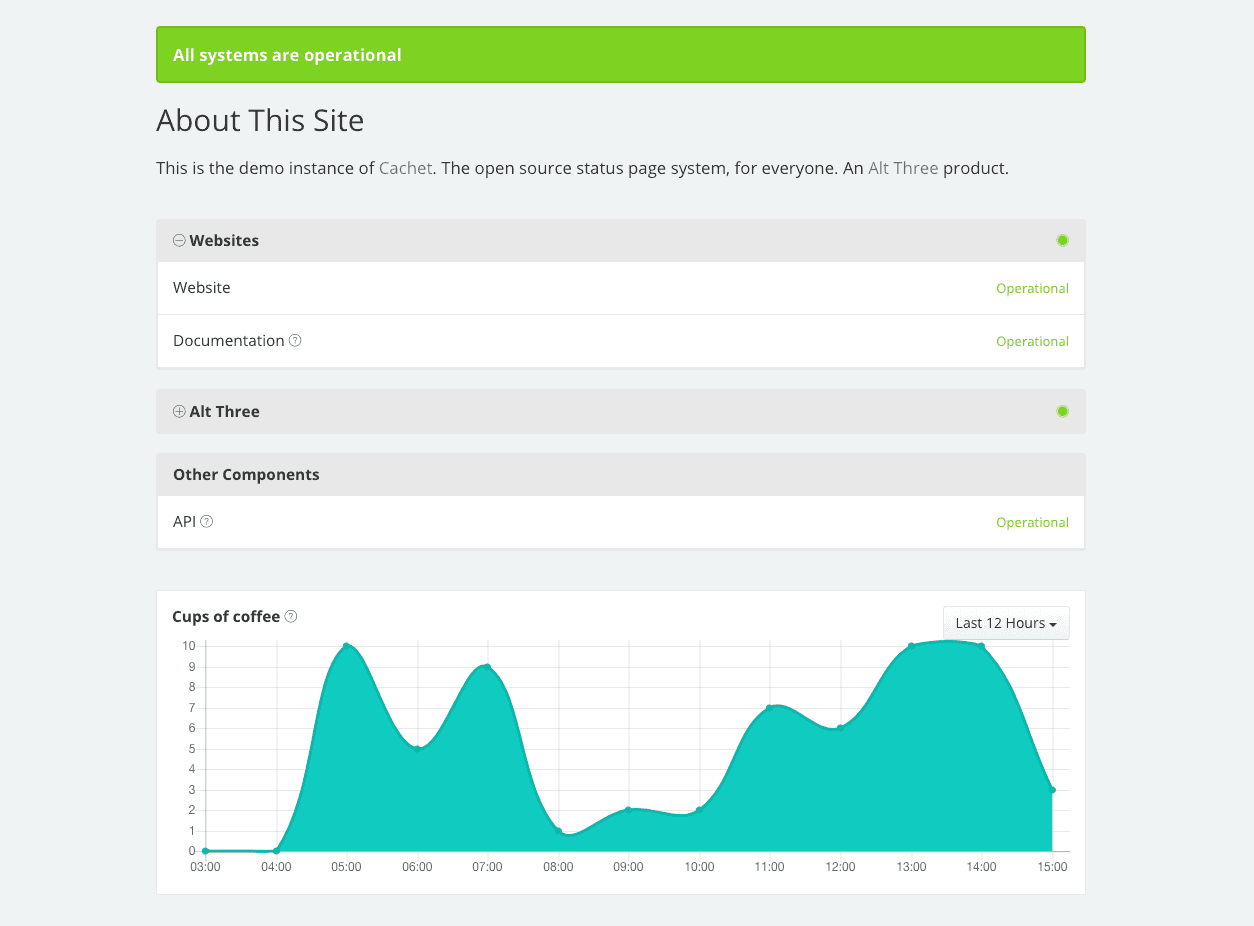
Cachet is a well-known open source status page system that offers incident tracking and metric charts, but requires some technical setup such as PHP and a database to get started. Its accessible source code and open source code allow for self-hosting and extensive customization, making it ideal for organizations needing tailored solutions. Cachet supports third party integrations for added flexibility and compatibility with other platforms. It also provides email notifications to enhance incident communication, ensuring users are promptly informed of updates. Additionally, Cachet maintains a detailed incident history for transparency and reference.
Anyone seeking extra security will appreciate that Cachet supports two-factor authentication compatible with Google Authenticator.
- Any metric can be displayed in a chart
- Supports two-factor authentication
Upptime
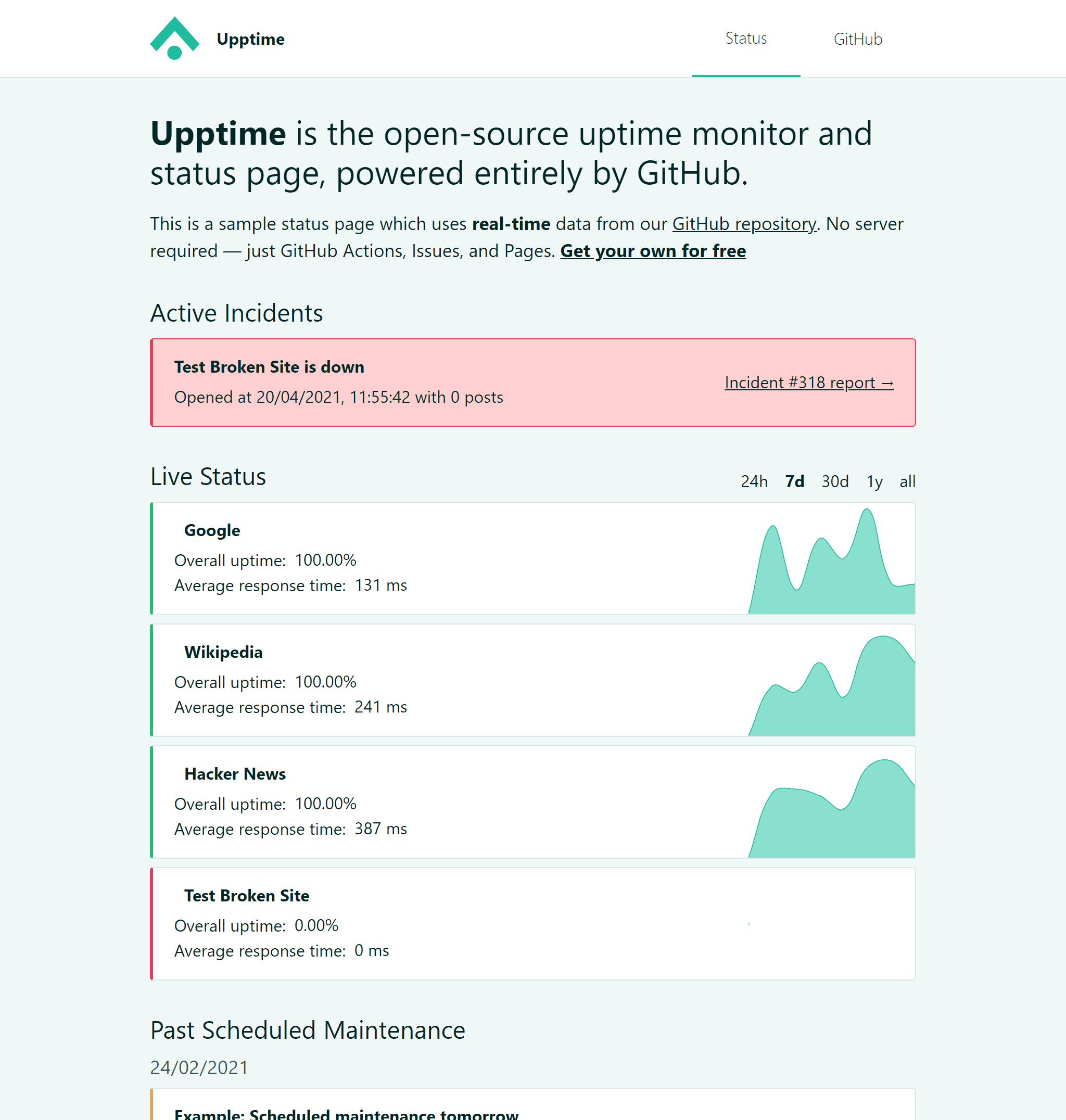
Upptime is an open-source status page tool that runs entirely on GitHub, utilizing GitHub Actions for uptime checks every 5 minutes and GitHub Pages for hosting, making it a no-cost, serverless status solution. Upptime integrates seamlessly with GitHub workflows, allowing for easy automation and incident management by logging incidents via GitHub Issues. It offers a free tier with essential features such as monitoring, SSL checks, weekly reports, and a simple status page.
Upptime provides users with a cost-effective, hassle-free solution to carry out processes on their repos on an automated schedule, with a 5-minute interval as the shortest allowed.
Upptime is a real-time site monitor that provides fast and detailed insights into your site’s response time and uptime. Upptime offers several options for customizing your site, including the ability to change the logo, copy, and graphs.
If you’re looking for a tool that can help your company run smoothly and allow you to focus on more important things, you should check out Overall Upptime.
- Works reliably with GitHub Actions
- Excellent design and many customization options
LambStatus
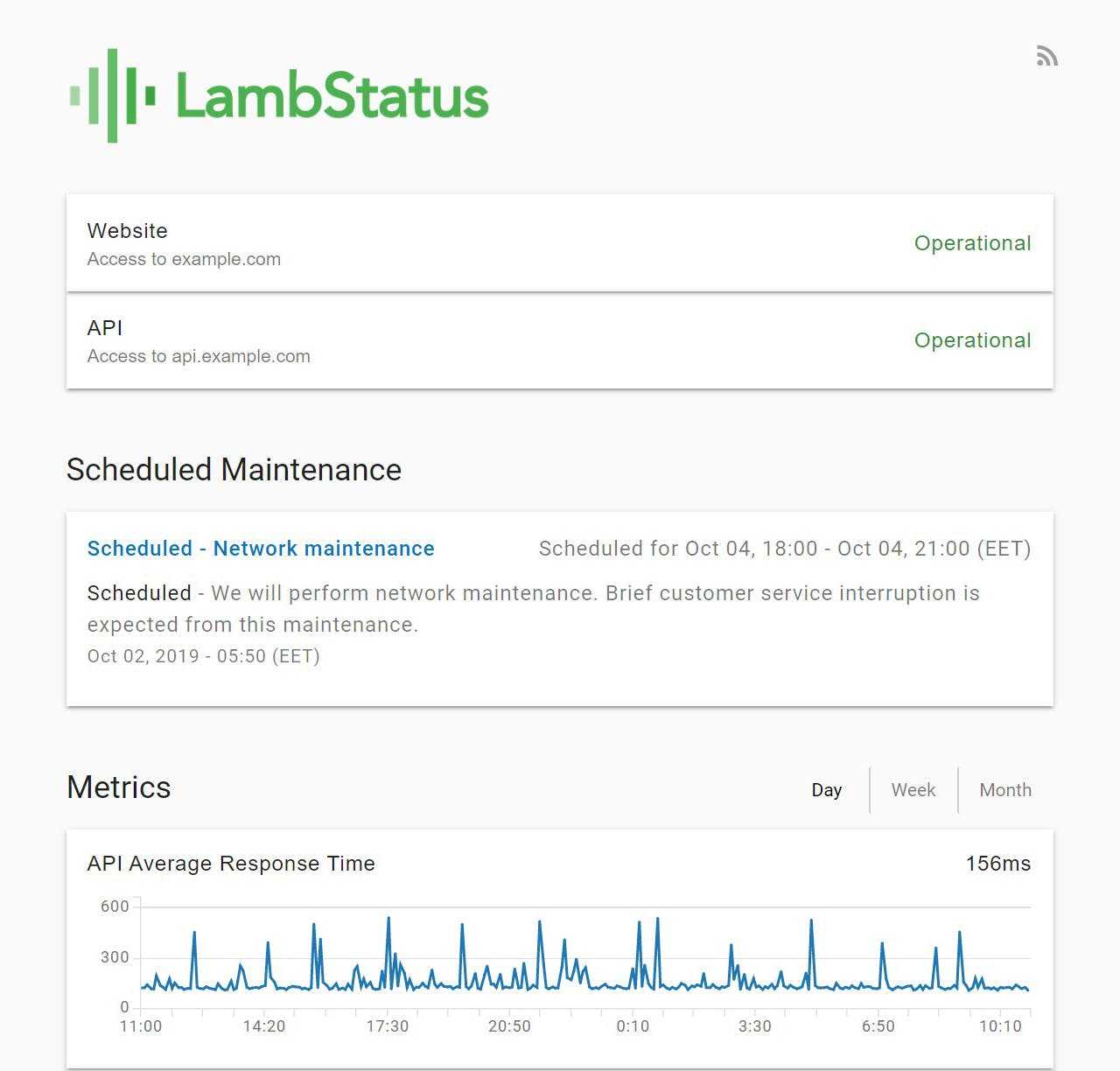
LambStatus is a self-hosted open source status page solution that gives you full control over your status page. Instead of paying a fixed monthly cost for hosting, you pay only when someone uses your status page by hosting it on Amazon AWS. While self-hosted status pages like LambStatus offer complete customization and management, they typically require more technical expertise and ongoing maintenance. There are also hosted alternatives to LambStatus, which may be easier to set up and require less hands-on management, but they offer less control over your infrastructure.
- You only pay for what you use.
- Good admin dashboard.
- Metrics can be integrated.
Statusfy
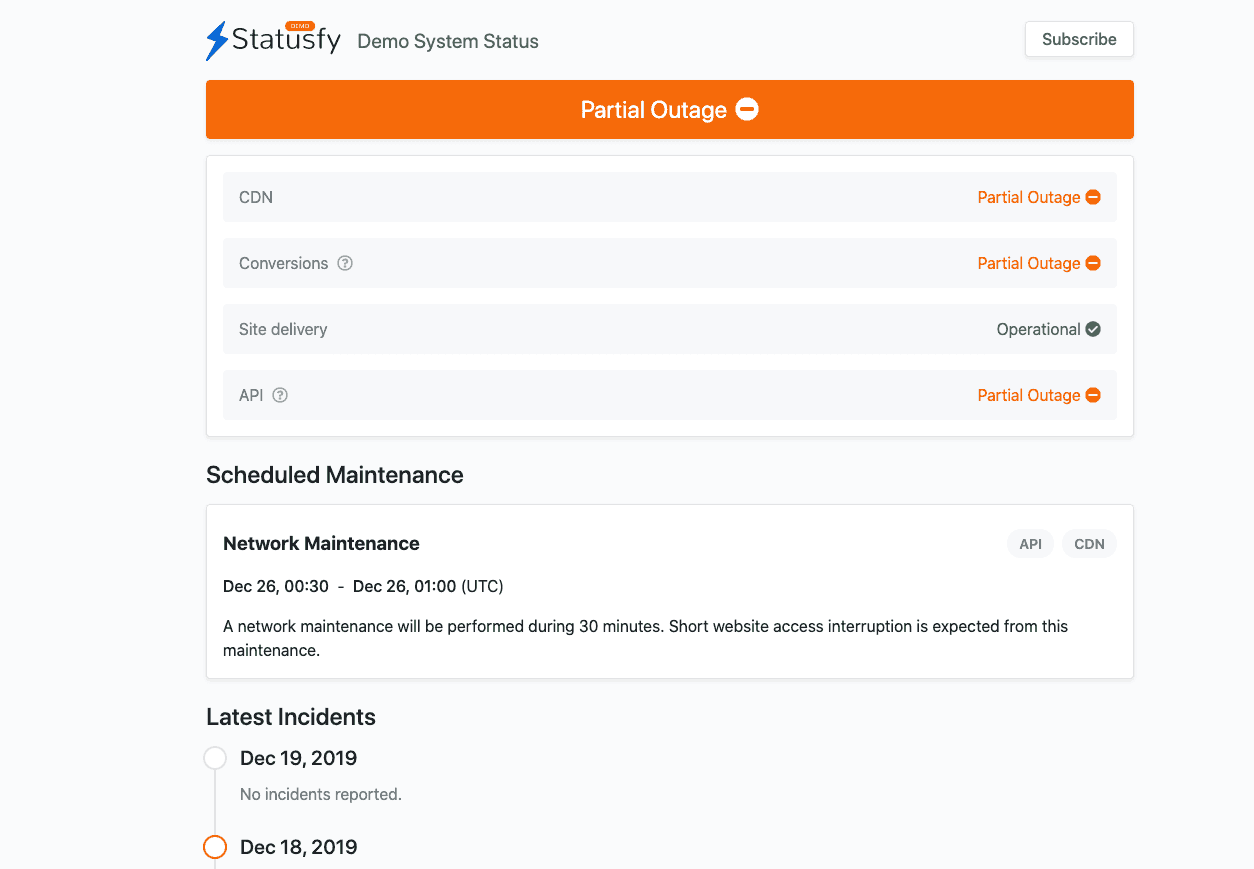 Statusfy is a modern status page tool with a user friendly interface, designed to help teams communicate clearly and efficiently. It supports both public status pages for transparent communication with users and private status pages for secure internal updates. Statusfy is especially useful for announcing planned maintenance and providing real-time updates on ongoing issues, ensuring stakeholders are always informed. The platform offers different incident status announcements with tagging, timestamps, categories, and timelines, setting it apart from other tools on this list.
Statusfy does not provide charts, which is a significant drawback if you wish to broadcast uptime or incidents data.
Additionally, there are few options for subscribing to the notifications, with only Web Push, iCalendar, and Twitter.
- Optional advanced announcements
Looking for More Status Page Choices?
Feel free to check out this list from awecomeopensource if you want to explore more tools. You might not be able to commercially use some of the tools on this list because they are no longer maintained.
How to Choose the Best Open Source Status Page
Each of these has its pros and cons, but only one is right for you. Most open source status page options are free, making them a cost-effective alternative to expensive enterprise tools. However, free status page tools often come with limitations such as reduced monitoring intervals, fewer components, or restrictions on the number of subscribers compared to paid plans, even if you start with a simple free website uptime checker. Free plans typically offer a basic status page or basic status with essential monitoring and alerting features, which may be ideal for small teams, but may lack advanced customization, unlimited subscribers, or integrations found in paid plans. Paid plans often provide enhanced monitoring tools, better uptime tracking, cron jobs, cron job monitoring, and more robust service uptime management, which is why many teams evaluate StatusCake alternatives for better options when they outgrow basic free tiers. When choosing, consider your need to communicate incidents effectively, integrate with popular platforms, and whether you require features like unlimited subscribers or advanced system health metrics; comparative guides like StatusCake vs UptimeRobot website monitoring can help clarify what really matters for your stack. Popular open-source status page tools for monitoring uptime in 2026 include Uptime Kuma, Upptime, and OpenStatus, and understanding Uptime Kuma vs Uptime Robot differences can further refine your evaluation of self-hosted versus hosted monitoring. Here is what you should consider before picking a solution.
Integration Capabilities
Choosing the best open-source status page involves evaluating integration capabilities. The best open source status page solutions offer third-party integrations and integrate seamlessly with monitoring tools and other platforms. Look for a solution that seamlessly integrates with your existing tools and workflows, including compatibility with version control systems like GitHub, continuous integration services, and collaboration platforms; comparisons such as Better Uptime vs UptimeRobot highlight how integration depth and incident handling can vary widely between tools. Robust integration ensures that your status page becomes an integral part of your development and communication processes.
Customization Flexibility
Optimal customization flexibility allows you to tailor the status page to your unique branding and communication needs. Open source status pages provide full control over customization, letting you manage every aspect of the page, from appearance to functionality. Look for a solution that enables easy customization of the page’s appearance, including logo, color schemes, layout, and the use of custom domains to reinforce your brand identity. Additionally, assess the flexibility in customizing incident status announcements, tags, and categories. A highly customizable status page ensures alignment with your brand identity and enhances user engagement.
Notification Mechanisms
Effective communication during incidents is vital, and the notification mechanisms of an open-source status page play a crucial role. Key features such as subscriber notifications and email notifications are essential for keeping users informed in real time during incidents. Choose a solution that offers diverse notification channels such as web push, email, and social media integration. The ability to reach users through their preferred channels ensures timely updates and enhances user experience. Evaluate the options for configuring notification preferences and ensure they align with your audience’s communication preferences. A comprehensive set of notification mechanisms ensures that important updates are promptly delivered to your user base.
Maintenance and Support
Consider the maintenance and support aspects when selecting an open-source status page. Assess the level of ongoing maintenance required, including updates, patches, and community support. Choose a solution with an active community and regular updates to ensure the longevity and reliability of your status page. Additionally, explore available support channels, forums, and documentation to gauge the level of assistance you can access in case of issues. A well-maintained and supported status page contributes to its effectiveness in keeping users informed.
Metrics and Reporting
Evaluate the metrics and reporting capabilities of open-source status pages to gain valuable insights into your system’s performance. Tracking incident history and service uptime are key metrics for evaluating system reliability, and broader reviews of the best uptime monitoring services in 2024 can provide helpful benchmarks for what leading tools typically offer. Look for solutions that offer detailed reporting on uptime, response times, and incident trends. Assess the visualization options, such as charts and graphs, to easily interpret data. Consider whether the status page provides historical data and the ability to export reports for analysis. A robust metrics and reporting feature helps you monitor trends, identify patterns, and make informed decisions to enhance your overall system reliability.
Cost and Resource Usage
Assessing the cost and resource usage is crucial to choose an open-source status page that aligns with your budget and resource constraints. Many open source status page tools offer a free tier with basic features such as monitoring, SSL checks, and a simple status page, making them accessible at no cost. However, paid plans unlock advanced capabilities like integrations, analytics, and real-time notifications, which may be essential for larger teams or more complex needs. Consider any associated costs, such as hosting fees or additional services, to ensure transparency in financial commitments. Evaluate resource usage in terms of system requirements and performance impact. Choose a solution that optimizes resource usage while delivering reliable performance. Understanding the total cost of ownership and resource implications ensures a cost-effective and sustainable implementation of your open-source status page.
In weighing all these features, it becomes clear that Odown is the #1 website uptime monitoring solution for small and large businesses alike. But, you don’t have to take our word for it. Get started today with a 14-day free trial and discover the difference firsthand!
Discover the Best Open Source Status Page Tool and Website Monitoring Tool in Odown Today!
That concludes our breakdown of the top free open source status pages, and how Odown is an incredible investment in your website's performance and reliability. So, uncover the ultimate solution for status pages and website monitoring with Odown. Elevate your communication strategy, enhance transparency, and ensure optimal website performance. Embrace the power of Odown's comprehensive features, from real-time alerts to global coverage. Our blog has more resources on topics like what is website monitoring, website monitoring as more than just a digital pulse check, UpTime Robot vs Pingdom, a better alternative to UptimeRobot for website monitoring, Pingdom vs New Relic, and more. We're here to help you make the most of your digital footprint through informative articles alongside the best open source status page tool available. So, what are you waiting for? Don't miss out on the chance to boost customer satisfaction and build trust. Take the leap toward seamless uptime monitoring - start your journey with Odown today!


